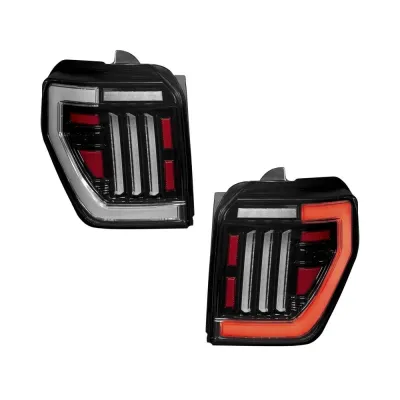
Drivers often wonder whether installing Smoked Led Tail Lights from carlamp-factory creates exposure to equipment citations when vehicles operate on public roadways. Federal Motor Vehicle Safety Standard 108 demands that rear lamps emit red light remaining plainly visible across specified distances under both daylight and darkness conditions. Any film spray or cover that reduces luminous intensity below mandated thresholds places the assembly outside compliance. Many jurisdictions treat such modifications as non-moving violations that generate fix-it tickets rather than points on driving records. Yet genuine risk remains if the chosen unit fails to preserve original photometric performance. Owners therefore ask themselves whether a given aftermarket product truly satisfies both federal self-certification markings and local visibility statutes before mounting it.
Assemblies engineered with high-output diodes behind lightly tinted lenses can retain necessary brightness while delivering the desired aesthetic effect. Manufacturers who stamp DOT symbols on housings thereby declare that photometric tests confirmed adequate candela levels and correct color coordinates. SAE references further signal adherence to established engineering benchmarks. Products carrying explicit off-road-only disclaimers announce outright that they fall short of those benchmarks and therefore cannot lawfully appear on public streets. Selecting units that carry clear compliance markings reduces the chance of roadside scrutiny during routine stops or annual inspections.
Visibility requirements typically call for red signals detectable from several hundred feet rearward under normal atmospheric conditions. Tint layers that obscure reflex reflectors or shift emitted color outside permitted boundaries violate those requirements in nearly every jurisdiction examined. Some states publish explicit prohibitions against any material that darkens lenses while others rely on general equipment statutes that officers enforce through visual assessment. In either framework the practical outcome remains similar: non-compliant lamps invite citations whose fines vary according to local schedules yet rarely escalate beyond civil penalties for first occurrences. Correctable violations often allow owners a window to restore original output and present proof of remediation.
Liability considerations extend beyond immediate tickets. Should a rear-end collision occur while non-compliant lamps reduce conspicuity the owner may face heightened exposure during subsequent claims review. Insurance carriers sometimes examine modifications when evaluating coverage continuity. Transparent disclosure of aftermarket lighting changes therefore forms a prudent practice. Assemblies designed from the outset around elevated diode output and efficient optics avoid these secondary complications by remaining inside the performance envelope defined by safety standards. Smoked Led Tail Lights produced under such controlled parameters help maintain the required red intensity without relying on added films.
Installation practices also influence ongoing legality. Plug-and-play units that interface cleanly with existing wiring harnesses minimize electrical faults that themselves could trigger equipment stops. Sequential functions when properly engineered continue to satisfy steady-burn requirements for stop lamps while offering distinctive signaling patterns. Owners should confirm that any sequential capability preserves the continuous red intensity demanded during braking. Periodic cleaning further ensures that accumulated road film never compounds intentional tint effects and drops output below thresholds.
Regional variation demands individual verification. Although federal baselines establish minimum performance floor each state or province may layer additional distance or brightness criteria. Crossing jurisdictional lines therefore requires awareness of destination rules. Assemblies certified to the strictest common standard provide the widest operational margin. Documentation supplied by the producer including photometric reports or self-certification statements supplies useful evidence should an officer request clarification during a stop.
Beyond pure compliance the visual character of tinted rear lamps continues to attract owners seeking cohesive vehicle appearance. Darker housings create continuous body lines that many contemporary designs favor. When that appearance arrives through certified high-output components rather than aftermarket films the dual goals of style and legality coexist. Owners who prioritize both attributes examine product literature for explicit statements regarding FMVSS 108 conformance before purchase.
Maintenance routines complete the compliance picture. Periodic verification that every diode cluster remains illuminated prevents partial outages that themselves violate equipment codes. Replacement of any failed segment restores full output. Storage of original packaging or certification labels allows quick reference during inspections. These habits keep the installed system inside legal parameters across its service life.
Selecting assemblies manufactured under controlled conditions further supports consistent performance. Production environments that maintain cleanliness standards and incorporate end-of-line photometric checks reduce the probability of units leaving the factory with marginal output. Buyers who source from established producers thereby gain additional assurance that stated compliance claims rest on actual test data rather than marketing language alone.
Owners who wish to explore specific Tesla-compatible options may examine the range available at https://www.carlamp-factory.com while confirming that each listed unit carries the necessary markings for intended road use. Careful matching of product specifications against both federal photometric criteria and local statutes remains the most reliable path toward avoiding equipment citations while achieving the preferred rear appearance with Smoked Led Tail Lights that stay within approved limits.