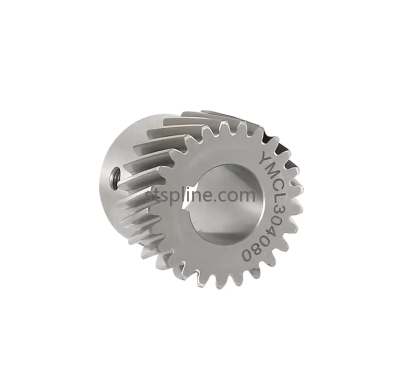
Specialized industrial equipment often requires transmission components that cannot be selected solely from standard dimensions. Custom Rack And Pinion solutions allow manufacturers to adapt the rack and pinion interface to particular machine structures, travel distances, mounting arrangements, and operating conditions. Effective customization depends on coordinating material selection, tooth geometry, machining, installation, and the requirements of the complete mechanical system.
Material selection is an important first step. Steel and other suitable engineering metals can be considered for industrial rack and pinion components because they provide useful combinations of strength, machinability, toughness, and resistance to repeated mechanical contact. The appropriate material should be selected according to the working environment and manufacturing route rather than simply choosing the hardest available option.
The rack and pinion operate together to convert rotary input into linear movement. The pinion rotates against the rack teeth, producing displacement along the rack's length. For this interaction to remain consistent, the two components must have compatible tooth geometry and manufacturing accuracy. When a transmission system is customized, the rack and pinion should therefore be developed as a coordinated pair.
Tooth geometry may be adapted according to the machine design. Customization can involve rack length, tooth arrangement, mounting features, connection methods, or other structural details. The objective is to create a component that fits the machine without compromising the basic transmission relationship. Accurate tooth profiles and consistent pitch help maintain predictable engagement as the pinion moves along the rack.
Machining technology determines how effectively these requirements can be achieved. Controlled milling and other precision processes can establish the tooth profile while maintaining critical reference surfaces. For customized orders, technical drawings and physical samples can provide useful information about the intended interface. Clear dimensional requirements are especially important when the rack must connect with existing machine structures or replacement components.
Surface treatment may also form part of the customized production process. Depending on the selected material and operating conditions, heat treatment can modify surface hardness and resistance to repeated contact. However, treatment must be carefully controlled because dimensional changes can influence the final fit. Post-treatment inspection can help confirm that the component remains within the agreed manufacturing requirements.
Mounting design is another area where customization can provide practical value. A rack may need to fit a particular machine frame, fastening arrangement, or guide structure. Accurate mounting references help position the rack relative to the pinion and the machine's linear guidance system. Stable installation is important because movement or misalignment can affect tooth contact even when the rack itself has been precisely manufactured.
Custom rack systems are applicable to CNC machinery, laser processing equipment, industrial robots, automated handling systems, and production-line equipment. These machines may have different frame dimensions and movement requirements, making flexibility in transmission design useful. A customized component can be developed around the machine architecture rather than forcing the machine structure to accommodate an unsuitable standard part.
Long travel systems may use several rack sections connected in sequence. In such cases, customization can include connection features or dimensions intended to support continuous installation. The tooth position at each connection must remain consistent so that the pinion can transition between sections without an abrupt change in engagement. Manufacturing tolerance and assembly accuracy both contribute to this requirement.
Quality inspection becomes especially important for customized components because the design may differ from standard production items. Manufacturers can inspect tooth geometry, dimensions, mounting features, surface condition, and other critical areas. Inspection procedures help verify that the finished component corresponds to the approved technical information and can reduce compatibility problems during assembly.
For B2B buyers, technical communication is an important part of customization. Drawings, samples, material requirements, operating conditions, and installation information can help establish a clear manufacturing specification. A supplier with experience in rack-and-pinion production can use this information to coordinate machining and inspection more effectively.
Maintenance should also be considered during customization. The selected material and surface treatment should be compatible with the machine environment, while the installation arrangement should allow appropriate inspection and servicing. Exposure to dust, chips, moisture, or other contaminants may influence the design of protective measures and maintenance procedures.
Customization is therefore not simply a change to component dimensions. It is an integrated engineering process involving materials, tooth geometry, machining, surface treatment, mounting, inspection, and application requirements. When these elements are coordinated from the beginning, the resulting transmission component can fit the machine more effectively.
For manufacturers developing specialized CNC equipment, robotics, automation systems, and industrial machinery, Custom Rack And Pinion solutions provide flexibility for adapting rotary-to-linear transmission to different mechanical designs. SOTER offers rack and transmission products for industrial applications, with related product information available at https://www.stspline.com/product/straight-teeth-rack/.